Digital Badge vs. Certificate vs. Certification: What's the Difference?

By Terri Varnell, SPHR, Chief Operating Officer, HRCP · Updated October 2026
Short answer: A certification verifies your knowledge against standards set by a professional body, usually through an exam, and you maintain it over time. A certificate shows you finished a defined course or program of study. A micro-credential recognizes learning in one focused skill or topic. A digital badge is an online, verifiable way to share a credential, with details on who issued it and what you did to earn it. A degree reflects an extended program of study.
These terms get used interchangeably, but they tell an employer very different things. At HRCP, we've helped more than 100,000 HR professionals prepare for certification since 1995, and in 2021 we launched Micro HR, our digital credentialing and badging program. Here's how the credentials compare and where each one fits in an HR career.
What is a credential?
A credential is any sort of skill, achievement, expertise, qualification, personal quality, or background that qualifies you for a particular role. Degrees, certifications, certificates, and micro-credentials are all credentials. The useful question isn't which one sounds most impressive. It's what each one tells an employer about your knowledge and skills.
What is a certification?
A professional certification validates your knowledge or proficiency against standards set by a professional body. In HR, that means credentials like the PHR® from HRCI or the SHRM-CP® from SHRM. Certifications usually have three things in common:
- A proctored exam you must pass
- Eligibility requirements, which may include work experience
- Ongoing education or recertification to keep the credential active
When you earn a certification, you can use its designation after your name. For an example of how one works, see What Is the PHR?
What is a certificate?
A certificate recognizes that you finished a defined course or program of study. It usually covers a narrower subject than a degree, and the amount of practice and assessment varies widely by program. Some certificate programs run for months; a certificate of completion may follow a single course.
The key distinction: earning a certificate doesn't make you certified. A certificate says you finished the learning. A certification says you met a professional body's standard, usually by passing its exam.
What is a micro-credential?
A micro-credential recognizes learning or demonstrated competency in a specific skill or topic. Because the scope is focused, you can build skills in manageable steps and show what you've learned along the way. Micro-credentials can:
- Build depth in an HR area you use at work, like benefits or employee relations
- Help you keep pace with changes in practices, technology, and employment law
- Stack toward a larger credential or learning goal
Time and cost commitments are usually lower than a longer program, but they vary, so look at what each micro-credential requires and offers.
What is a digital badge?
A digital badge is a way to share a credential online. Many micro-credentials, and some certifications and certificates, are now represented by one. The image is only one part of the badge. Behind it is information such as:
- Who issued it
- What the recipient had to do to earn it
- When it was awarded
- Depending on the badge, the skills assessed or evidence of the work
That detail matters. Two badges can look alike but represent very different levels of learning or assessment, so employers can look past the image to judge the achievement. Issued through a platform like Credly, a badge also gives others a way to verify its source online. We cover how to read one in How to Evaluate Digital Badges on Someone's Resume.
Badges are also far more common than they were a few years ago: the 2025 Badge Count from 1EdTech and Credential Engine reports that the number of badges issued grew from 74.7 million in 2022 to 320.4 million in 2025, though more badge platforms reported in 2025, so the two counts aren't a direct comparison. Employers see value in the learning behind them, too: in a 2023 UPCEA and Collegis Education survey, 95% of organizational leaders said they saw benefits from microcredentials, most often because they show an employee's willingness to develop their skills (76%).
Where do degrees fit?
A college degree or diploma reflects an extended program of study at an accredited school. It gives you a broad foundation that supports many career paths, while certifications, certificates, and micro-credentials tend to be narrower and more job-focused.
How do these credentials compare?
Here's a side-by-side look at the five credential types:
| Credential | What it shows | Typical requirements | Who issues it | How it's verified |
|---|---|---|---|---|
| Degree | Broad foundation from an extended program of study | Multiyear coursework and credit hours | Colleges and universities | Transcript or diploma from the school |
| Certification | Knowledge or proficiency measured against a professional standard | Eligibility, a passing exam score, and ongoing recertification | Professional bodies (in HR, HRCI and SHRM) | Issuer's records or credential verification |
| Certificate | Completion of a defined course or program | Finishing the coursework; assessment varies | Schools, training providers, and associations | The certificate itself or the issuer's records |
| Micro-credential | Learning or competency in one focused skill or topic | Short courses, often with an assessment | Training providers, schools, and associations | Often a digital badge, or the issuer's records |
| Digital badge | An online, shareable record of a credential | Whatever the underlying credential requires | The credential's issuer, often through a platform like Credly | A link showing the issuer, criteria, and date |
Notice that a digital badge isn't really a separate level of achievement. It's a format. What matters is the credential behind it.
Weighing certification against other options? Take our free HR Certification Fit Assessment for a recommendation in minutes.
Which credential is right for you?
These credentials serve different purposes and can complement one another. In my experience, it comes down to your goal:
- If you want a recognized, career-wide standard, look at an HR certification.
- If you need to fill a specific knowledge gap now, a micro-credential is a practical step.
- If you're building toward certification, micro-credentials let you show progress along the way.
Focused credentials can make a real difference. One of our customers, Akieva, earned the Micro HR Employee Benefits badge while trying to move into benefits and landed a Benefits Administrator role shortly afterward. For a closer look at the payoff of certification, read Is HR Certification Worth It?
How does Micro HR connect badges, certificates, and certification?
Micro HR brings several of these credential types together. Here's how it works:
- More than 80 micro courses, ranging from 5 minutes to 2.5 hours, with most taking 30 minutes to an hour
- To finish a course, you answer every assessment question correctly, with as many retries as you need
- You receive a certificate of completion for each course
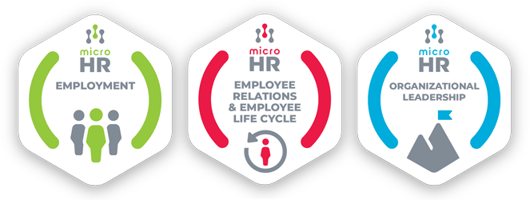
- Groups of courses earn digital badges: 13 HR badges and 7 business badges
- Badges are issued and verified through Credly
Our customers use Micro HR badges as standalone credentials, to earn recertification credits (the courses are pre-approved by HRCI), and as a step-by-step path toward certification. The 13 Micro HR Badge Bundle + HR Certification 2,150 Question Test Bank pairs all 13 HR badges with a 2,150-question test bank, including a practice exam for each HR topic and full-length mock exams. It lets you earn credentials as you study the HR topics covered on the certification exams, so you can show your progress along the way.
Ready to start building credentials? Browse Micro HR badges or explore HRCP certification prep.
Frequently asked questions about badges, certificates, and certifications
Is a certificate the same as a certification?
No. A certificate shows you finished a course or program of study. A certification shows you met a professional body's standard, usually by passing an exam, and typically requires recertification to stay active.
Is a digital badge the same as a micro-credential?
Not exactly. A micro-credential is the learning or competency you earned. A digital badge is one way to display and verify a credential online. Many micro-credentials are issued as digital badges.
Can a digital badge replace an HR certification?
No. A badge shows focused learning in a specific area, while a certification like the PHR or SHRM-CP verifies broad HR knowledge through a proctored exam. Many HR professionals use badges alongside certification or as steps toward it.
Do Micro HR badges count toward HR recertification?
The courses required for Micro HR badges are pre-approved by HRCI. You retrieve your activity codes and certificates of completion at HRrecert.com and submit each code through HRCI's website. Other credentialing organizations may accept the courses, subject to their own requirements and approval.
Do digital badges expire?
Some do. Each Micro HR digital badge is valid for three years from the date of completion and can be renewed by retaking the required micro course or courses. Credly posts the expiration date on your badge.
PHR and SPHR are registered trademarks of HRCI. SHRM-CP is a registered trademark of SHRM. HRCP is an independent exam prep provider and is not affiliated with HRCI or SHRM.